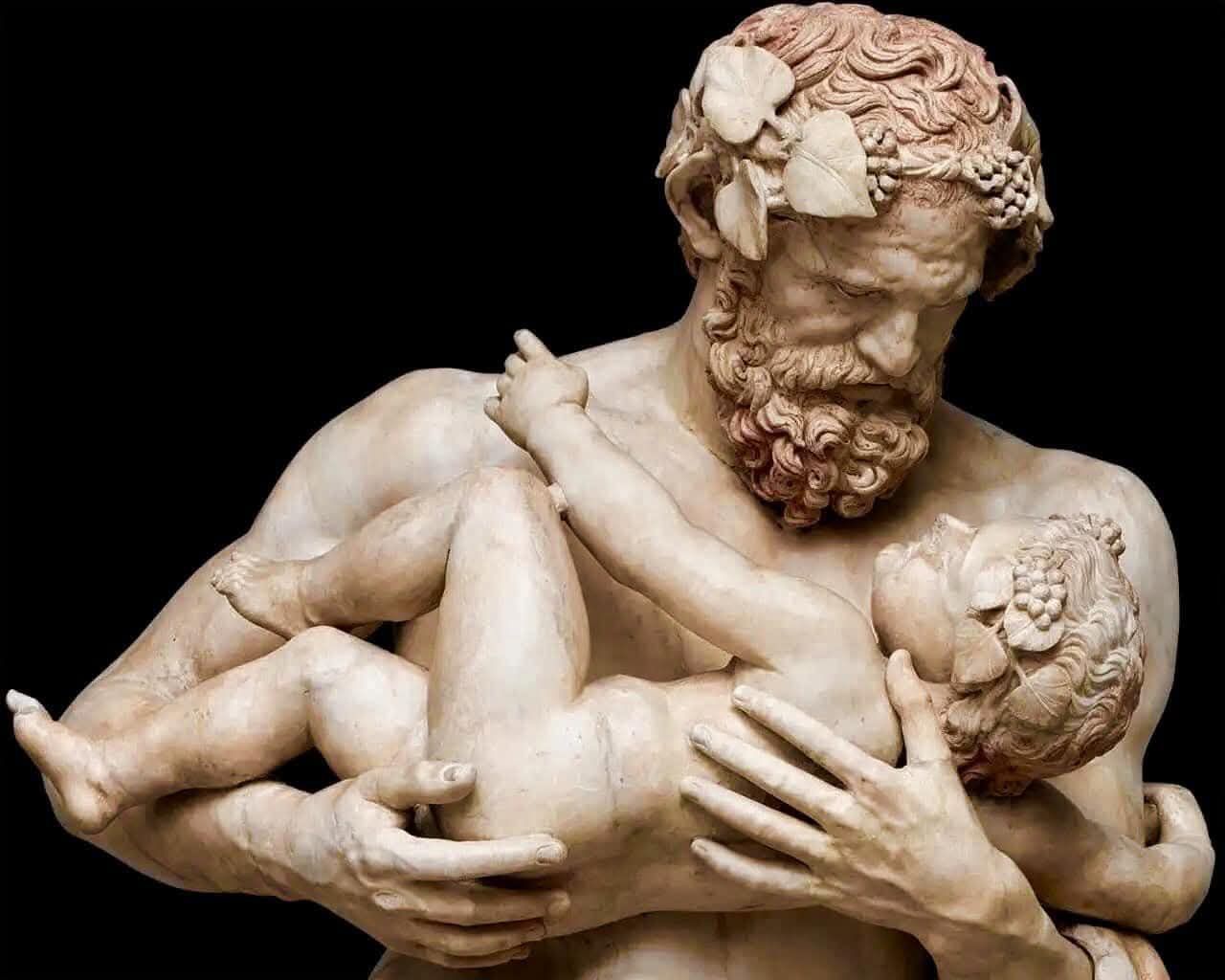
Bacchus in the arms of Silenus
On a sculpture in Rome
The old man holds the child as men do,
horizontally and unprepared for a sudden squirm.
But those strong hands are gentle,
the stone eyes soft.
The father of revelry beholds the face
of a newborn god and contemplates,
contemplates through decades and dirt,
through sunlight and silence,
through crowds and restorations and flash bulbs.
In the naked, fragile-fingered baby he foresees
a master of celebration.
And is that fear for the child which furrows his forehead?
Is it awe at the audacity to lead a dance
when the world prefers a race,
or a broken plod?
The Romans would ban the impropriety
of celebrating with such a child-god,
or with another infant who would say,
“drink in remembrance of me,”
who also would resurrect and pour out
the blood-red wine of all the life he had to spare.
Silenus beholds Bacchus
as the Father does the Son,
with great solemnity and then a resolution:
“despite all, they will rejoice.”
Peter
That breakfast at the beach
was all that I’d been longing for:
the fish on the coals,
the sun rising over the rippled sea,
My Lord taking the bread from the stones
and tearing it,
silently, and silently
eating with us squatting on the sand.
Though the Man—strange
how I knew him, but only half
recognized his face—
though He was present
as ever man had been to food
or to the unspoken wonderings
of the boys gathered on the shore
in the mist,
even so,
I was distant from him
as one seashore to the other.
When I had said,
“I do not know him”
by that other fire in the courtyard
in the city,
I indeed lost my knowing
and he became a stranger to my eyes.
When we walked again
from the boat, along the sea,
I told my Lord I loved him.
Three times I told him,
and by the third I knew the man
in all his stark beauty.
My soul shattered.
He spoke to me then of growing old.
He commanded, or promised,
(they were always the same to him)
that I would stretch out my hands
like the cripple in the synagogue
who reached out for healing,
but like my Christ
a six-inch spike of iron
would twist these strong wrists.
Growing old and growing into a child
are the same, he said.
The nail and the making new
are one.
He held out his hands for mine.
When I touched the deep divots in his wrists,
the strangeness between us shriveled away like mist,
and I beheld a joy
greater than any child’s.
The years and labors
have sometimes scudded
between my eyes and that golden light,
but tonight in this close cell
I hear again the voice of my Joy,
the voice which breaks and heals,
the voice young and ancient as the stones,
promising pain
and commanding in its beauty,
“Follow me to the end.”
John 21, Luke 22
Slave or Free
My brother said it can’t be helped.
There’s just a way work rules his mind,
the way wind bends across a ridge
to twist soft snow in a whirling shaft.
The Lord of laughter said, long ago,
that bowing before an idol
and bending under a yoke
of foreign slavery
was all the same.
The labor never satisfied:
all effort and attentiveness were snatched
into the wasting words of masters
or the keening silence of gods unknown.
The Lord then said a surprising thing:
not, "Strike back! Rise up! Flat refuse,"
but (he drew close and quiet to the ear
of the weary-shouldered slave)—
“Listen, child, and the listening
will be a freeman’s feast.”
The tired-trembling slave,
this tired-trembling slave,
found the Voice to be enough.
Isaiah 55
The Secret Song
Already the smallest children are gathering
to sink their hands into the wool,
the warm white wool,
of the Lamb.
Then come the women who always longed
for husbands and for children,
the women who in all their loneliness
kept young and soft
their hearts and their delight.
A few priests come next,
whose faces are now fresh
but whose eyes are old
as the sum of all those nights
they gathered the groans of the world
into their prayers.
These holy, eager ones
follow the Lamb close,
close,
and he teaches them a song.
Only the childlike
may learn that melody,
for only the childlike
bear on their face
the thumb-traced signature of God.
Theirs is a song composed in holy spite
of cosmic wars
and plagues and death;
and in the sweetness of that strain
the angel armies are renewed.
As the blameless sing the secret song—
listen, listen!
—its sound swells into a fearful thundering,
and the beasts tremble
and the angels find their boldness
to declare the final coming of the Lord.
Revelation 14
Sainte Terre
Holy ground demands bare feet,
feet as tender as a child’s,
feet which cannot run away.
When my toes sink into soil,
my watchfulness resonates
the Attention that hallows the place.
My bare presence, too, makes sacred
the dust and foliage,
for where I Am meets Here I Am,
where we saunter together in the coolness of the garden,
the stones themselves cry ‘holy!’
and declare themselves the staircase
to the throneroom of the Lord.
Exodus 3, Genesis 28
This night your soul is required
It was evening when the rich man entered the courtroom.
He was used to courts,
to chambers of sunny limestone, of satin cushions,
of Roman protocols.
But this court was different.
The candles wavered in a wind—
or was it a breath? —
that his skin could not feel.
The room was named Fear.
A judge’s voice swirled through the shadows
and sank into the lowest chambers of his heart.
“This very night your soul is required of you.”
“To whom is it owed?”
the wealthy man asked.
“To the One who lent you breath.”
Another whining, wearying voice interceded:
“But he gave it to me already.
And it’s a thin-worn, dirty thing,
not fit for a king.”
The businessman knew the second voice.
It had kept him company for years.
He addressed the whiner:
“Did you ever pay me for my soul?”
“Yes, oh yes, I take care to the last farthing.
I have paid you in my currency:
death, waste, death.
In fact, I paid too generously,
and you owe it back:
the death penalty for the rich man!”
“And heaven demands the life penalty,”
said the voice of command.
“He gave you life, you owe him life,”
echoed the cavern-court walls;
“I gave you death, you owe me death,”
the whiner demanded.
Suddenly, the earth-echo went silent.
Then, “He is coming,” the stones whispered—
“He who gives the devil his due
and this dead son his life.”
I cannot describe the Light
that then fell on the rich man’s eyes,
but in its glory he saw
what he never saw before:
a wealth, neither in the currency of Rome
nor of the devil,
wealth as of wildflowers
or a grandmother’s mercy,
wealth given by the Lord of Light
who pays all debts.
Luke 20